


Fire Extinguishing

Fire Safety Management for Commercial Facilities: A Complete Guide for Facilities Managers (South Africa)
Managing fire safety across malls, warehouses, office blocks, parking garages, and data centres requires more than buying fire extinguishers and hoping for the best. It requires a practical plan that links fire extinguishing systems, portable fire extinguishers, staff readiness, and compliance documentation—so that equipment works when needed and your building remains safe, insurable, and operational.
In South Africa, your fire protection responsibilities sit alongside the National Building Regulations (NBR) and the OHS Act. The OHS Act places a general duty on employers to provide and maintain a working environment that is safe and without risk to employees, which naturally includes managing fire hazards in workplaces. https://www.gov.za/documents/occupational-health-and-safety-act
“Every employer shall provide and maintain, as far as is reasonably practicable, a working environment that is safe and without risk to the health of his employees.”
— Occupational Health and Safety Act 85 of 1993, Section 8. Government of South Africa
This guide focuses on fire extinguishing in the real world: choosing the correct extinguisher, placing it intelligently, maintaining it properly, and training people so a small incident does not become a shutdown-level emergency. It also explains how to think about fire suppression in layers—portable equipment, hose reels, hydrants, alarms, and fixed suppression—so you can manage risk across multiple tenants and multiple hazards.
How fire extinguishing actually works in buildings
Before you talk brands, sizes, or pricing, make sure your team understands the fundamentals.
Fire requires three elements to ignite: heat, a fuel source, and an oxygen supply—often called the fire triangle. Fire extinguishing methods are confirmed by how they disrupt one or more sides of that triangle:
- Cooling removes heat (common in water based extinguishers and some water mist solutions).
- Smothering reduces oxygen at the flame zone (foam blankets, carbon dioxide discharge).
- Chemical inhibition interrupts the combustion chemical reaction (dry chemical and dry powder agents).
A facilities manager should also recognise a fourth, practical principle: starvation. Starving a fire of its fuel source will eventually extinguish it when no flammable materials are available. That may mean isolating fuel valves, clearing combustibles, or stopping the feed of packaging materials on a conveyor.
SANS 10400-T (Fire Protection) describes expectations for the provision and maintenance of fire-fighting equipment and fire protection systems so they are ready for their purpose. Ndlambe Local Municipality
Understanding fire classes (and why it matters to equipment selection)
Commercial buildings face different fire classes across different zones. The correct extinguishing agent depends on the class of fire and the risks around it.
Specific extinguishers are used for fire classes: A (solids), B (liquids), C (gases), D (metals), and F/K (cooking oils). This simple classification matters because using the wrong extinguisher can make the incident worse (for example, spreading burning liquids or damaging electrical equipment).
Quick Reference: Fire Extinguisher Selection Guide
| Fire class | Typical fuels | Common facility areas | Recommended extinguisher type | Notes |
|---|---|---|---|---|
| A (solids) | ordinary combustibles (paper, wood, textiles) | offices, retail, storerooms | water extinguishers, water based fire extinguisher | best for cooling |
| B (liquids) | flammable liquids | warehouses, parking areas, plant rooms | foam extinguishers, dry powder fire extinguisher | avoid plain water |
| C (gases) | flammable gases | plant areas, some workshops | dry chemical / dry powder | isolate gas if possible |
| D (metals) | combustible metals | workshops, specialised storage | class d extinguisher | special media only |
| F/K (oils) | cooking oils & fats | commercial kitchens | wet chemical extinguishers | reduces re-ignition |
Important note for mixed-use facilities: In many buildings, you will use a combination approach—general-purpose units in corridors and common areas, and specialised units at known hazards (electrical rooms, kitchens, workshops).
Risk assessment across malls, warehouses, offices, parking garages, and data centres
A strong extinguisher plan begins with a documented risk assessment that maps hazards by area. Use this as a practical checklist:
1) Identify ignition sources
- Overloaded plugs, damaged extension cords, and ageing distribution boards
- Hot work (cutting, welding, grinding)
- Cooking equipment and grease extraction systems
- Vehicles and battery charging areas
- Mechanical plant with friction heat
2) Identify fuels and fuel loading
- combustible materials in storage: cardboard, packaging, plastics, textiles, timber
- Liquids: fuels, solvents, paints, cleaning chemicals (flammable liquids)
- Gases: LPG and other flammable gases
- Special risks: lithium batteries, combustible metals, metal shavings and powders
3) Understand consequences (what damage is unacceptable?)
Data centres and comms rooms can suffer severe collateral damage from powder residue. Retail and warehousing can suffer major downtime from smoke damage and sprinkler activation. Kitchens can spread fire into ducts and ceilings.
4) Match the extinguishing method to the space
- Avoid agents that create unnecessary water damage near sensitive equipment.
- Consider ventilation: in confined spaces, avoid using dry powder or CO2 extinguishers because they can reduce visibility and oxygen levels.
- Plan for post-incident recovery, not just “knockdown”.
Types of fire extinguishers used in facilities
Many facilities teams treat extinguishers as “red cylinders”. Procurement teams should be more precise.
There are two main types of fire extinguishers: stored-pressure and cartridge-operated.
- Stored-pressure portable fire extinguishers are the most common type. The propellant and extinguishing agent are stored in the same cylinder.
- Cartridge-operated extinguishers contain the expellant gas in a separate cartridge that is punctured before discharge. In some applications they can deliver discharge at higher pressure and may be used where robust performance is needed.
Fire extinguishers are further divided into handheld and cart-mounted types:
- Handheld units are used for fast first response in corridors, plant rooms, and tenant spaces.
- Cart-mounted units are used in large, high-risk zones such as loading bays, chemical stores, or large warehousing where capacity and reach matter.
Placement rules that stop “paper compliance”
A key operational reality is that a perfectly serviced extinguisher is useless if it is blocked by stock or hidden behind signage.
Practical placement principles for commercial buildings:
- Place fire extinguishers in high-traffic areas and along escape routes so they are easy to locate under stress.
- Keep them accessible and unblocked.
- Use clear signage and update signage after tenant fit-outs.
“The disposition of such fire-fighting equipment shall be clearly visible at all times or shall be indicated by symbolic signs…”
— SANS 10400-T extract. Ndlambe Local Municipality
Global reference note (useful for multinational tenants): Some international guidance states a height limit of 60 inches for extinguishers under 40 lb, with ADA considerations of 48 inches. Use this as a practical accessibility benchmark where relevant, but always align to your local authority requirements.
Inspection, servicing, and competence (South African reality)
Check extinguishers monthly for pressure gauge readings and ensure they are accessible and unblocked. This “simple” step prevents many failures.
Most countries require regular fire extinguisher maintenance by a competent person as part of fire safety legislation. In South Africa, competence matters. SAQCC Fire explains that compliance is based on specifications in relevant standards, including SANS 1475 for servicing of portable fire extinguishers (and related equipment). Fire Safety App
SAQCC Fire resources highlight the need for registered competent persons and appropriate permitting for servicing work linked to SANS 1475.
Maintenance schedule (practical and audit-friendly)
| Task | Frequency | Responsible party | Evidence to keep |
|---|---|---|---|
| Visual checks: access, signage, pin/seal, damage | Monthly | Facilities team | Monthly checklist + photos |
| Gauge check / weight check (CO2) | Monthly | Facilities team | Log + exceptions list |
| Full service | Annual | Competent service provider | Service certificate + tags |
| Hydrostatic testing (global reference) | 5 years (water/CO2) | Approved workshop | Test report |
| Hydrostatic testing (global reference) | up to 12 years (dry chemical) | Approved workshop | Test report |
| Refresher training | Annual | Safety officer / HR | Attendance registers |
Global reference notes for context:
- In the United States, state/local codes often require checks every 30 days, with annual service by a qualified technician.
- NFPA 10 is widely used internationally as a reference for fire extinguisher selection and maintenance (not a South African standard, but often referenced by global insurers and engineers).
- In the UK, extinguishers must conform to BS EN3 colour requirements, and in Australia AS/NZS 1841 uses signal red plus a coloured band.
- The use of Halon gas is prohibited in the UK except in limited specialised applications (e.g., aircraft and certain military/police contexts).
A brief history of fire extinguishers (why modern servicing standards exist)
Facilities teams often inherit mixed fleets of equipment. Understanding the history helps explain why standards tightened over time.
- The first fire extinguisher was patented in England in 1723 by Ambrose Godfrey.
- A portable pressurised fire extinguisher (“Extincteur”) was invented by British Captain George William Manby in 1816.
- The soda-acid extinguisher was patented in 1866 by Francois Carlier (France).
- The cartridge-operated extinguisher was invented by Read & Campbell (England) in 1881.
- The chemical foam extinguisher was invented in 1904 by Aleksandr Loran (Russia).
- The carbon dioxide extinguisher was invented by the Walter Kidde Company in 1924.
- In 1928, DuGas introduced a cartridge-operated dry chemical extinguisher.
- In the 1940s, Germany invented liquid chlorobromomethane for aircraft use.
- Halon 1211 was introduced to the United States in the 1970s from Europe.
The first fire extinguisher patents were issued in the 19th century, with significant advancements occurring throughout that century—driven by industrialisation and the need for reliable, portable fire suppression.
Fire extinguishing for facilities managers is about repeatable readiness. You want staff to find the right extinguisher in seconds, use it safely, and know when to evacuate.
In case of a fire, the fire alarm should be triggered before attempting to use a fire extinguisher. This aligns with practical emergency management: alert occupants, start evacuation, and mobilise the response plan before anyone engages with a fire.
Only attempt to extinguish a fire that is small and contained, such as one the size of a wastebasket. If it is spreading, producing dense smoke, or involves unknown hazards, your safest decision is evacuation and emergency services activation.
After extinguishing a fire, monitor the area for re-ignition and report the incident to the fire department if any extinguisher was used. Even small fires can re-ignite from hot spots or hidden burning material.
Operator safety rules (non-negotiable)
- Maintain a distance of 6 to 8 feet from the fire, keep a clear exit behind you, and position yourself for a quick escape.
- If they choose to proceed, operate from 6 to 10 feet away and sweep the base of the fire until extinguished.
- If you feel unsure, evacuate immediately. Fire extinguishers should ideally only be used by someone who has been trained to do so.
P.A.S.S. in commercial facilities (make it muscle memory)
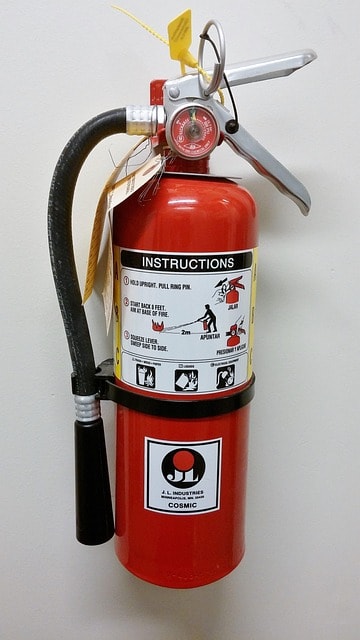
The P.A.S.S. technique stands for Pull, Aim, Squeeze, and Sweep—a proven way to standardise how staff use fire extinguishers.
- Pull the pin (break the seal)
- Aim the spray nozzle at the base of the flames
- Squeeze the handle to discharge the extinguishing agent
- Sweep side to side until the fire is out
Fire extinguishing systems in commercial buildings (portable + fixed, planned as one programme)
Facilities teams often treat portable equipment as separate from fixed protection. In practice, your best results come from managing fire extinguishing systems as a single programme, with clear boundaries between:
- Portable first response (portable fire extinguishers placed where staff can reach them quickly)
- Manual water delivery (hose reels and hydrants that support trained responders)
- Automatic fire suppression (sprinklers, clean agent, or water mist solutions designed by competent specialists)
SANS 10400-T links many building types to requirements for fire protection measures (including the provision and maintenance of fire-fighting equipment and systems), and it emphasises that equipment should be maintained so it is ready for its purpose. Ndlambe Local Municipality
Treat fire extinguishing systems as an asset portfolio: corridors, plant rooms, tenant spaces, and special hazards each need the right hardware, the right placement, and the right service plan. Document the decision for each zone: the likely fire class, the chosen extinguishing agent, and how that choice fits into your overall fire extinguishing systems strategy (portable, manual water, and engineered suppression).
A layered approach (how facilities managers should document it)
- Prevention controls (housekeeping, hot-work permits, electrical maintenance)
- Detection and alarm (so people evacuate early and response is coordinated)
- Portable intervention with the right fire extinguishers for the likely fire classes
- Water infrastructure (reels/hydrants where required) to limit spread
- Engineered fire extinguishing systems for high-value risks (data centres, kitchens, special hazards)
When you document your fire extinguishing systems this way, audits become easier and procurement becomes more consistent—because you are buying and servicing the right mix of fire extinguishers and fixed solutions, not “whatever was on special”.
A facilities manager’s fire extinguishers checklist (placement, readiness, and records)
Use this checklist monthly and during tenant fit-outs. It is designed to reduce “paper compliance” and improve real readiness of fire extinguishers.
12-point monthly checklist for fire extinguishers
- Confirm fire extinguishers are visible (or correctly signed) and not hidden behind stock.
- Confirm fire extinguishers are accessible and unblocked (no pallets, bins, or displays in front).
- Confirm the pin and tamper seal on fire extinguishers are intact.
- Confirm pressure gauge readings are in the green (where fitted) on fire extinguishers.
- Confirm CO2 fire extinguishers show correct weight (where applicable).
- Confirm mounting brackets are secure and fire extinguishers are not loose or corroded.
- Confirm labels on fire extinguishers are readable (class ratings and instructions).
- Confirm the location signage for fire extinguishers is present and visible from approach angles.
- Confirm the correct extinguisher is present for the hazard (e.g., kitchens have wet chemical, not water).
- Confirm newly installed equipment is logged: asset ID, location, type, service due date (for all fire extinguishers).
- Confirm contractors have not moved or removed fire extinguishers during work.
- Record exceptions and action dates (repair, replacement, service call-out) for any fire extinguishers found non-compliant.
SAQCC Fire resources highlight the need for registered competent persons and appropriate permitting for servicing work linked to SANS 1475.
Sample fire extinguishers register (what auditors typically want to see)
| Area / floor | Fire extinguishers type | Fire class coverage | Asset ID | Last service | Next service | Notes |
|---|---|---|---|---|---|---|
| Reception | Fire extinguishers (ABC dry powder) | A/B/C | EX-001 | 2025-01-12 | 2026-01-12 | Clear access |
| Electrical room | Fire extinguishers (CO2) | B / electrical | EX-014 | 2025-01-12 | 2026-01-12 | Weight checked monthly |
| Food court | Fire extinguishers (wet chemical) | F/K | EX-032 | 2025-02-03 | 2026-02-03 | Tenant to brief staff |
Class a fires in offices and retail: how to reduce repeat incidents
Class A incidents are often “small fires” at the start—bins, storerooms, copier areas, or packaging near a plug point. The best strategy for class a fires is a blend of prevention and the correct extinguisher choice.
- Keep waste areas controlled: overflowing bins become fuel sources for class a fires.
- Control storage: do not stack cardboard against distribution boards.
- Improve housekeeping in tenant back-of-house areas where class a fires commonly start.
Water extinguishers are effective for Class A fires, because they cool the burning solids and reduce the heat generated. For facilities teams, reinforce that water extinguishers are only used for Class A fires (ordinary combustibles like wood and paper), not liquids or electricity.
Common “fuel source” mistakes that allow class a fires to grow
- Storing cartons in electrical cupboards
- Leaving packaging in corridors overnight
- Stacking promotional materials near lighting and power points
If you remove the fuel source early—by clearing combustible storage and controlling waste—then class a fires are far less likely to escalate.
Class A fires involve ordinary combustibles like paper, textiles, and wood. They are commonly found in offices, retail stores, storerooms, and tenant back-of-house areas.
Water extinguishers reminds staff: Class A only. Water extinguishers are effective for Class A fires, and water extinguishers are only used for Class A fires, because applying water to burning liquids or energised electrical equipment can increase danger.
Practical Class A controls
- Reduce fuel load through housekeeping and storage discipline.
- Control ignition sources (overloaded plugs and poor cable management).
- Keep corridors clear so extinguishers and exits stay accessible.
When Class A becomes a major incident
Class A fires can spread into ceilings, voids, and HVAC pathways. If smoke production increases fast, focus on evacuation and compartmentation rather than portable intervention.
Class A checklist for facilities teams
- Do we have enough water based fire extinguisher coverage for office and retail zones?
- Are water extinguishers clearly labelled “Class A only” on signage?
- Are extinguishers visible during peak trading and stock periods?
- Are escape routes clear and illuminated?
Managing a flammable liquid fire without making it worse
A flammable liquid fire behaves differently to a solid-fuel fire. A flammable liquid fire spreads across the liquid surface, and the aim is to blanket it and interrupt vapour release.
- Foam fire extinguishers can blanket and cool the surface, reducing vapours.
- Carbon dioxide can knock down flames by displacing oxygen, but watch for re-ignite if hot surfaces remain.
- Dry chemical agents interrupt the combustion chemical reaction and can provide rapid knockdown.
Remember: Foam smothers and cools Class A & B fires but should not be used on electrical fires.
Class B fires involve flammable liquids and burning liquids such as fuels, oils, solvents, and certain cleaning chemicals. These hazards show up in warehouses, loading bays, plant rooms, generator areas, and parking garages.
A flammable liquid fire spreads across the surface of the liquid. This is why water is not typically used: it can splash, spread the fuel, and increase fire growth.
Best-fit extinguishers for Class B
- Foam extinguishers can be used on both Class A and Class B fires, including flammable liquids, because foam can blanket the liquid surface.
- Carbon dioxide extinguishers work by displacing oxygen and are suitable for Class B and electrical fires.
- Dry powder extinguishers are effective for Class A, B, and C fires, making them common in mixed-risk corridors and plant areas.
Critical safety fact: Foam smothers and cools Class A & B fires but should not be used on electrical fires. In electrical rooms, you generally want CO2, clean agent solutions, or a designed fixed system.
Class B response steps (simple and safe)
- Trigger alarm and call for help.
- If safe, stop the leak or isolate the container (starve the fire of fuel source).
- Use the correct extinguisher: foam fire extinguishers for liquid surface fires, or a dry powder fire extinguisher where multi-risk exists.
- Sweep low across the burning liquid surface; do not splash or “jet” the liquid.
- Watch for re-ignite conditions and report the incident.
Electrical fires are common in commercial buildings because electrical loads are dense: distribution boards, UPS systems, server racks, kitchen appliances, lifts, access control systems, and HVAC.
For facilities managers, the operational rule is:
- Raise the alarm first
- Isolate electricity where safe
- Use the right extinguisher
- Evacuate if unsure
Carbon dioxide extinguishers are suitable for Class B and electrical fires because CO2 displaces oxygen without leaving residue. However, in confined spaces, avoid using CO2 extinguishers if it will compromise breathing air and visibility—evacuation may be safer.
Electrical room controls (Reminder list)
- Keep doorways clear, no storage in electrical rooms.
- Thermal scan high-load panels.
- Control unauthorized work (permit-to-work).
- Keep correct signage and clear labeling of isolators.
Fire suppression note: In data centres, you may require engineered fire suppression (clean agent or water mist) to protect equipment and limit downtime. That is part of a broader fire protection system, not just portable extinguishers.
Water mist options for sensitive areas
In some commercial environments—especially data centres, control rooms, and high-value plant—traditional water based extinguishers may create unacceptable water damage, and dry powder residue may create unacceptable collateral damage.
This is where water mist extinguishers can be considered as part of a broader fire protection system. Water mist works by producing very fine droplets that absorb heat efficiently and can reduce oxygen availability in the immediate flame zone, depending on design.
Practical facilities note: Only adopt water mist extinguishers where they are appropriate for your risk profile and where your fire engineer or competent specialist confirms suitability for the hazards and the room design.
Dry chemical
Dry chemical extinguishing agents work by interrupting the combustion chemical reaction. In practical facilities terms, this means fast knockdown across multiple hazards—one reason these units are so common.
Dry powder extinguishers are effective for Class A, B, and C fires, which is why a dry chemical / dry powder fire extinguisher is often the “default” general-area unit.
Benefits and trade-offs
Benefits
- Rapid extinguishing across mixed hazards
- Effective where flammable liquids and ordinary combustibles may both be present
- Reliable in many outdoor or semi-outdoor zones
Trade-offs
- Powder residue can cause collateral damage to equipment
- Powder clouds can reduce visibility, especially in confined spaces
- Cleanup time can increase business interruption costs
Dry chemical and the combustion chain reaction (why powder works)
Dry chemical agents are effective because they interrupt the combustion chain reaction. In simple terms, they interfere with the free-radical chemical reaction that allows a fire to keep producing flames.
This is why dry chemical and dry powder fire extinguishers are so common in mixed-risk environments: they can knock down flames quickly, even when the exact fuel mix is uncertain.
Dry powder extinguishers
These extinguishers (often ABC-rated) are usually the backbone of many commercial building strategies because they cover multiple fire classes with one unit.
Where they work well
- Parking garage cores and ramps
- Warehouse aisles and loading bays
- Plant rooms (where compatible)
- Mixed-use corridors
Where to be cautious
- Data centre white space (powder contamination risk)
- Commercial kitchens (use wet chemical instead)
Dry powder
Practical signage copy (helpful for multi-tenant sites)
Use simple, repeated messages:
- “ABC Dry Powder – General Areas (A/B/C)”
- “CO2 – Electrical / Liquids”
- “Wet Chemical – Cooking Oils”
- “Water – Class A Only”
This reduces misuse under pressure and supports your fire extinguishing plan.
Class d fires
Class D fires involve fires involving combustible metals. These are less common in malls and offices but can appear in workshops, machining areas, and specialised storage environments.
Class D extinguishers are designed for fires involving combustible metals and use special media to smother and isolate the burning metal. Water and foam can be dangerous on many metal fires, so Class D planning must be specific to your site’s processes and materials.
Class D readiness checklist
- Identify which combustible metals exist onsite (magnesium, sodium, titanium, etc.)
- Confirm the correct Class D extinguishing agent for those metals
- Train only designated responders for these areas
- Keep clear separation between metal hazards and other fuels
Class d
If your building includes a metal workshop or specialised tenant, don’t guess. Confirm the exact metal hazards and align your extinguisher selection, training, and fire protection system accordingly.
Class k fires
Class K fires (often called F/K in different standards) involve cooking oils and fats in commercial kitchens, food courts, and tenant restaurants.
Wet chemical extinguishers are specifically designed for Class K fires, where the fuel is hot oil or fat.
Why you must not use water on grease fires
Water should not be used on kitchen grease fires because it can explode and spread the fire. Instead, use wet chemical extinguishers and (where required) fixed kitchen fire suppression systems.
Cooking oil
Cooking oil fires can continue burning, flare and re-ignite quickly because oil retains heat. Your response plan should prioritise:
- Alarm activation and evacuation coordination
- Isolating heat sources
- Applying wet chemical correctly
- Monitoring for re-ignition
Suppression note: Many commercial kitchens need designed extraction and suppression measures to prevent fire spread into ducts and ceilings.
A short FAQ (helps tenants and supervisors)
Do we need different fire extinguishers for different areas?
Yes. Mixed-use buildings should have different fire extinguishers matched to risk: water for Class A areas, CO2 for electrical rooms, wet chemical for kitchens, and general-purpose dry chemical powder where risks overlap.
How often should we check fire extinguishers?
Check fire extinguishers monthly for access and pressure/weight, and keep service certificates up to date. If any fire extinguishers are used, they must be replaced or recharged immediately.
When should we evacuate instead of using fire extinguishers?
Evacuate if you feel unsure, if smoke increases, if the fire is not small and contained, or if you do not have a clear escape route.
Training and drills (South African facilities reality)
Training is not optional if you expect safe intervention. FPASA’s training material includes basic fire theory, methods of extinguishment, and practical use of fire extinguishers and hose reels—useful benchmarks for facilities teams building competency. FPASA+1
What to include in your training programme
- Fire classes and extinguisher selection (Class A/B/C/D/F-K)
- P.A.S.S. method and safe distance rules
- “When NOT to fight a fire” decision-making
- Evacuation roles and assembly point accountability
- Reporting and post-incident procedures
Where ERF Group fits in
ERF Group supports South African commercial facilities with compliant supply, placement planning, servicing, and documentation—so your fire extinguishers and broader fire extinguishing systems are ready when needed.
Our support typically includes:
- Site review and risk mapping across mixed-use environments
- Correct selection of portable fire extinguishers (including water extinguishers, foam extinguishers, dry powder extinguishers, CO2, and wet chemical)
- Servicing programmes aligned to competence expectations and documented for audits
- Signage, brackets, reels, hydrants, and spares to complete the fire protection system
- Practical training support and drill guidance
Contact us: https://erfgroup.co.za/contact-us
Related Posts
Fire Extinguisher Prices in South Africa: A Practical Buyer’s Guide
TL;DR: Fire extinguisher prices in South Africa vary by agent, capacity, construction and supplier. Current…

Dry Powder Fire Extinguishers: Uses, Limitations and Buying Guidance
Dry powder fire extinguishers are widely used across commercial, industrial and vehicle environments because they…

9 kg Fire Extinguisher Prices: What Facilities Teams Should Compare
A 9 kg dry powder fire extinguisher is often selected for commercial, industrial and vehicle-related…
Leave a Reply